“Since time immemorial, people have used drugs for the simple reason to make themselves feel better – whatever ‘better’ means….”, says Dr Thomas Szasz with a wry smile and a heavy Hungarian accent in his lecture ‘The Right to Take Drugs’.
To put it another way, it’s ok to feel good. It’s even good to feel good. In fact, the right to feel good is about your autonomy, your body, and your mind, and if you’re an American it’s your constitutional right: to life, liberty, and the pursuit of happiness.
Euphoria is a good thing. Yes, euphoria is a good thing. That something so straightforward and self-evident needs to be spelled out and repeated as the entire political spectrum across the West continues to collectively lose sight of this most basic of truths again and again and again is a testament to how our societies have got horribly and worryingly screwed up.
One of the greatest freedoms, abilities, or gifts we have as humans is our capacity to alter our mood and consciousness at will through the use of drugs – be they synthetic, semisynthetic, or natural. As people who are into cannabis, that makes our willingness to be swept up in the escalating, relentless pathologizing and medicalizing of everything – and most especially of ‘drugs’ and ‘drugs users’ – not just fucking stupid but profoundly sinister.
This sinister negativity runs deeper than the will to power and control, or the institutionalised sadomasochism of addiction psychiatry, militarized policing, and mass incarceration – all of which come down to little more than politics and economics, not least psychiatry, ‘the astrology of the sciences’.
The Drug War in all its authoritarian, racist, and progressive forms has criminalized and restricted a powerful force for good – for peaceful coexistence – one that’s never been more urgently needed than amid the ongoing vicious backlash against liberalism and multiculturalism.
The collective euphoria created through the shared experience of drugs is among the greatest of social levellers, and the unrivalled power of bliss to transcend and break through barriers of culture, to equalise, and to bring humans together as one through the energy of ecstasy – of just plain happiness, if you prefer – now more than ever needs to be reclaimed from the doctors and shrinks and pharmaceutical corporations with their surveillance capitalism, cops the fucking lot of them….
***
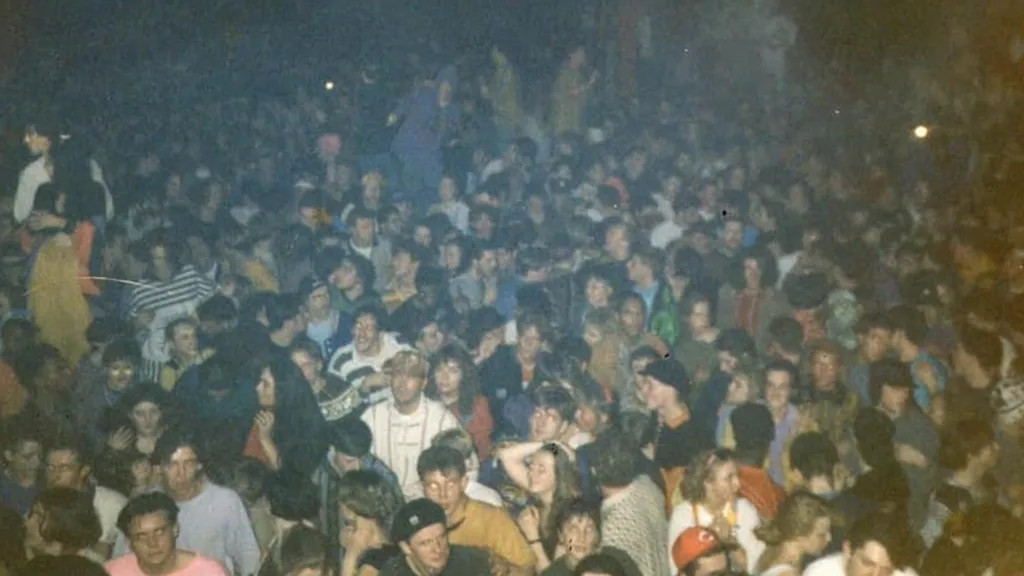
From Detroit to Berlin to Manchester, young people without expensive social science degrees or copies of the DSM-III discovered all this for themselves in the 1980s: the magic of music, dance, and drugs could heal their broken communities. In the deindustrialized north of late ’80s England, that meant healing communities torn apart by the miners’ strikes, the bloodshed and hunger caused when Thatcher ordered them put down, cut off state welfare, and gave free rein to extreme police brutality. As described by Jeremy Deller in ‘Everybody in the Place’, warehouses in Lancashire and fields off the M25 orbital became sites of a ritual transition out of this pain, as Britain itself moved out of the industrial age into an uncertain future.
But as then Shadow Home Secretary Tony Blair silently looked on, the boot of the Tory state – the Schnieder ‘top boot’ of the aristocratic bloodhound hunt – stamped on the face of this new generation of young, post-industrial Britons. Their ecstatic free parties were broken up and their tribes of nomadic New Age Travellers were outlawed and hunted down under the Criminal Justice Act of 1994. Eyes full of wonder at new ways of life, new rituals, and the timeless human freedoms they’d rediscovered within the disorientating upheaval of a now dis-United Kingdom, these kids, ravers, and vagabonds – uprooted from lost communities back home – just as suddenly found themselves beaten, cuffed, and chained, or hounded into exile in Berlin or Eastern Europe.
The cage doors of police vans and prison wards were then slammed on a whole array of possible modes of being and potential futures. Once again, England’s dissenters lost.
But the smug pinstriped arseholes who smiled derisively at warnings that the Criminal Justice Bill would begin a slow, irreversible slide into terminal unfreedom might want to wipe the grins off their faces, if any are left. Or perhaps they needn’t bother. The shattering alienation of the era of the mobile phone, the panopticon of mass surveillance, surging antisemitism, and a deranged and dangerous new political nihilism that spans from left to right will likely do that for them, soon enough. What little remains of the establishment old guard can kiss goodbye to everything they took for granted and their self-assurance. This time it’s their world that looks set to get turned upside down, permanently – and ours too, of course, as the new populist right strengthens its hold on a confused and angry England and eyes the general election of 2029, ready to pull Britain out of the ECHR and dismantle the Human Rights Act.
***
Drug bans are no better than book bans and book burning or a surveillance camera in every home or inside every head. Something to bear in mind when you hear any self-described liberal, progressive, or conservative voice support for anything short of a total end to drug prohibition.
“Censorship is a much better concept for the understanding of drug prohibition than any ‘disease model'”, states Szasz, expounding on his crucial work, Ceremonial Chemistry: The Ritual Persecution of Drugs, Addicts, and Pushers.
As Will Self notes in a profile of Szasz, “Anthropologists who study the use of intoxicants in different cultures have a radically different view of the phenomenon we call ‘drug addiction’ and ‘alcoholism’ than do the medical and legal establishments who make it their business to police what we do with our consciousness.”
For Szasz, “The illegal status of drugs in our culture was a function of what he termed ‘professional closure’ on the part of the medical and pharmacological professions.
“To a doctor, who wishes to maintain his exclusive right to prescribe drugs, the spectacle of people self-medicating is an intolerable infringement, a challenge to his source of income and expertise.”
Or as Self himself puts it: “‘Alcoholics’ and ‘drug addicts’ are merely that statistically definable component of our collectivity who are paying with their lives for our inability to take a more constructive view of intoxication.”
Those of us with friends or family who have paid with their lives because of this failed policing of other people’s bodies and minds – the so-called War on Drugs – will understand how very lightly Self is saying what needs to be said.
***
These and other insights are expanded upon by Szasz in Our Right to Drugs: The Case for a Free Market.
The featured photo is from the website Flashback and shows a 1980s warehouse rave in Blackburn.