Tune in to an interview with David Watson – aka, Sam the Skunkman – in which the legendary underground cannabis breeder discourses upon his seed collection and the crucial importance of preserving cannabis landraces in order to be able to create the advanced cannabis cultivars of the future.
A controversial figure, Watson is widely credited with breeding Skunk #1, which in the reckoning of most experts with real experience of working at scale is the only modern high-THC cannabis hybrid that’s genuinely true-breeding.
Based on the interview, it seems Watson sold his seed collection to Bioarc Ltd, a Melbourne-headquartered corporation. Unless there’s good reason to think otherwise, it’s fair to assume that puts the collection out of reach of the rest of us for the foreseeable.
Given the collection is Watson’s, arguably it’s his call as to its future – though proponents and signatories of the Nagoya Protocol might argue that ‘tribal’ minorities in Kerala or the citizens of Lebanon should also be given in a say in this decision, as might Afghans, Laotians, Thais, and anyone else from the many countries where Watson ‘collected’.
But before we let ourselves get too carried away by tides of righteous indignation or talk of ‘biopiracy’, any arguments you can raise against Watson’s decision more than likely apply to the strain you’re toking right now and every other variety you can find in ‘quite liderally’ any dispensary, coffeeshop, or online seedbank catalogue on Planet Earth.
To which it might also be added, ‘good luck’ buying pot that was created in the West between now and sometime around – let’s say – 1985 which doesn’t bear Watson’s fingerprints somewhere down the Mendelian line. There are diagrams of the cannabis genome designed for processing by us human meat-computers that are already in the public domain, of which the more accurate and comprehensive show modern high-THC hybrids as near enough a ‘Skunk No. 1 clade’. To put it another way, along with the genetic resources of most of Asia, Skunk No. 1 is in fecking everything you’re smoking.
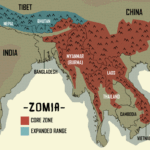
To unpack the ethical implications of that observation – since all of us, it seems, increasingly care a lot – will the Thai Gen Z’s now blazing ‘Blue Dream’ etc. etc. etc. in Bangkok be compensating Afghan farmers for the overwhelmingly Afghan contribution to everything they’re getting wrecked on? And will the Afghan farmers in Khyber Pakhtunkwa currently cashing in on ‘Cadillac Rainbow’ or whatever new fad variety (allegedly new alleged variety) that’s the flavour-of-the year for 2025 be indemnifying Thais for its inevitable and undeniably essential ‘Sativa’ fraction? Might the justly recompensed Thais in turn ‘shake the superflux’ of that indemnity to the Lao, the Lao to the Tai Dam, the Tai Dam to whichever of 30 Tibeto-Burman speaking minorities in Yunnan, and they in turn to some final exonym-free village of one hundred-and-something speakers of a vanishing Qiangic dialect in the valleys of the Hengduan Mountains from where their ‘Thai stick’ ganja landraces might ultimately derive?
And how would this morally vital process of redress work exactly? Who will mediate between signatories and non-signatories of the Nagoya Protocol? Should interested parties seek justice at the UN? Settle out of court somewhere in a smoky alley in the Hague? Or call a loya jirga and hash it out through Pakhtunwali in Nagoya…?
…now there’s something I’d like to see…. I propose Legoland Japan…. Bring your Samurai swords, war elephants, and jezails!
Anyway, more seriously…
Looking more closely at Bioarc since I first posted this piece, it’s good to see that at least some sound people such as Rob Clarke are involved with the project, however unabashedly capitalist.
Whatever your views, and however tightly you hold them (or tell yourself you do), the fact is that to get cannabis research and preservation back on track and redress the effects of decades of misguided policy, what’s needed is for loads of organizations, public and private, to be working on landraces and wild-type material, in as decentralized a way as possible. Projects such as Bioarc are a necessary part of this mix.
My worries after looking closer at Bioarc’s videos are that (1) the seeds were stored at 5 °C for several decades and (2) with a collection of the stated size, one organization alone will be hard-pressed to get anywhere near realizing its potential.
Reading between the lines, it appears Bioarc had plans to work on tropical germplasm in Thailand. If so, given the current Thai government’s intent, those could be up in the air.
Cautionary tales abound for situations such as this. Beyond cannabis, there are all-too-many cases of germplasm collections held by breeders or big agribusinesses being left to rot. Breeders retire or die or management decides the projects are not sufficiently profitable, and everything is lost.
Hard realities such as these are why there has to be a lot more cooperation if cannabis is to be got on the right path to the kind of future most of us would like to see – and to get on that path and stay on it means a lot more decentralization and international cooperation.
For an authoritative history of foundational cannabis strains such as Skunk #1 and Afghani #1, have a listen to this interview with Mel Frank, who recounts from first-hand experience the role Watson played in the emergence of the Dutch cannabis seed industry after relocating from southern California to Amsterdam in the 1980s.
What’s crucial to appreciate if we’re talking biodiversity and breeding is that early underground seedbanks such as Sacred Seeds or Positronics, and the indoor farmers who supplied Dutch coffeeshops, utilized only a very small range of cultivars / strains. You could count the best of them on one hand.
Check out the coffeeshop menus and seedbank catalogues of the ’80s and early ’90s to get a sense of how everything getting grown was – and still is – based on a clutch of outstanding foundational cultivars such as Northern Lights, Afghani #1, Haze, and Skunk #1.
Taking for granted some latitude as to the genetics these names denoted even in the earliest phases of the Amsterdam cannabis boom, the illusion of diversity that came later with the proliferation of ‘strain names’ is when the severe confusion really begins. Around the turn of the Millennium, we arrive in a new era in which all but a very few of these names correspond to any actual underlying botanical reality.
Look beyond the flavour-of-the-month miasma today and very rarely will you find seed lines and cuts that aren’t ultimately based on those original Dutch–American genetics of the late ’80s Amsterdam heyday – based most particularly on cuts of Northern Lights or Skunk #1.
And here’s the irony. In their pristine original form, foundational lines of the ’80s and ’90s such as any true Skunk or Haze can deliver very distinctive highs – distinctive in the sense that they really stand apart from the generic foggy blandness typical of contemporary dispensary cannabis and offerings from online seedbanks.
According to Dr. Reggie Gaudino, a molecular geneticist who specialises in plant phytochemistry, the key reason for this difference is that decades of breeding single-mindedly for high levels of THC have narrowed the resin profile of modern hybrids.
Ever-increasing percentages of THC not only make for a flawed constricting, and inaccurate definition of potency, they come at the expense of all other components of cannabis resin – terpenoids and non-terpenoids. In other words, boosting THC has forced out or diminished thousands of phytochemicals in cannabis that we know little or nothing about, but which are very likely involved in imparting this plant’s more desirable effects.
In Europe and America, there’s a refrain you’ll hear time and again from aficionados and former tokers alike: bud these days just isn’t the same as the old-school cannabis they used to love – the cannabis that got them into toking in the first place. All agree that what’s changed most critically is the buzz. Modern stuff might look good in a plastic bag but too often doesn’t get you high so much as leave you feeling blearily flat, wrong right from the outset. This is why, when commercial indoor production boomed in Europe around the turn of the millennium and imports of traditional cannabis dried up, many folks just gave up on cannabis altogether – not because cannabis got stronger, as is so often claimed, but because it stopped feeling good.
Get into is this topic with connoisseurs from the States and soon enough you’ll hear a name that’s come to signify everything that’s lacking about North American strains: Cookies. The Cookies brand has become a byword for weed that’s bone-dull, its product so generically generic that it’s won for itself a meme-like status in US cannabis discourse – the shorthand for pot that’s missing every essential quality that you need from pot.
The alternative is what shines through when you experience good heirlooms and landraces: a high that’s all positivity. Really, it’s as simple as that. Old-school herb is feel-good herb.
“Jeez, the buzz is nice on this stuff”, writes one life-long American aficionado after his first experience of our ‘1990 Haze x Skunk #1’. “Up, clear, and warm.”
In the Heirloom section of this site, you can find absolutely authentic cannabis heirlooms such as Skunk Special, Durban Skunk, and Master Kush, all of which are from seeds we obtained ourselves in Amsterdam in 1990 and put into long-term storage. Using the original seeds, we’ve resurrected these foundational cultivars exactly as they were in the ’89/’90 season. Now, there really is no need to take my or anyone else’s word for it. You get to experience the difference for yourself.